
1. What can be found at the enterprise edge?
• Internet, VPN, and WAN modules• Internet, PSTN, and WAN services
• server farms and network management
• campus infrastructure, including access layer devices
2. In which functional area of the Cisco Enterprise Architecture should IDS and IPS be located to detect
• and prevent services from accessing hosts?
• Enterprise Campus
• Edge Distribution
• Enterprise Edge• Service Provider Edge
3. A business consultant must use Internet websites to research a report on the e-business strategies of several firms and then electronically deliver the report to a group of clients in cities throughout the world. Which two teleworker tools can the consultant use to accomplish this project? (Choose two.)
• VoIP
• VPN
• HTTP• Telnet
• email
4. Which two measures help ensure that a hardware problem does not cause an outage in an enterprise LAN that supports mission critical services? (Choose two.)
• providing failover capability
• installing redundant power supplies• purchasing more bandwidth from the ISP
• implementing broadcast containment with VLANs
• installing routers that can handle a greater amount of throughput
5. Which task would typically only require services located at the access layer of the hierarchical design model?
• connecting to the corporate web server to update sales figures
• using a VPN from home to send data to the main office servers
• printing a meeting agenda on a local departmental network printer• placing a VoIP call to a business associate in another country
• responding to an e-mail from a co-worker in another department
6. How does a VPN work to support remote user productivity?
• It uses SSL to encrypt remote user logins to the corporate intranet.
• It uses secure Telnet for remote user connections to internal network devices.
• It creates a virtual circuit that allows real-time communications between any two Internet endpoints.
• It uses encapsulation to create a secure tunnel for transmission of data across non-secure networks.
7. A remote user needs to access a networking device on the internal network of the company. The transactions between the remote user and the device must be secure. Which protocol enables this to happen securely?
• HTTP
• SSH• Telnet
• FTP
8. What does VoIP provide to telecommuters?
• high-quality, live-video presentations
• real-time voice communications over the Internet• ability to share desktop applications simultaneously
• secure, encrypted data transmissions through the Internet
9. Which functional component of the Cisco Enterprise Architecture is responsible for hosting internal servers?
• enterprise campus• enterprise edge
• service provider edge
• building distribution
10. What is the purpose of the Cisco Enterprise Architecture?
• remove the three-layer hierarchical model and use a flat network approach
• divide the network into functional components while still maintaining the concept of Core, Distribution, and Access Layers• provide services and functionality to the core layer by grouping various components into a single
• component located in the access layer
• reduce overall network traffic by grouping server farms, the management server, corporate intranet, and e-commerce routers in the same layer
11. Which two solutions would an enterprise IT department use to facilitate secure intranet access for remote workers? (Choose two.)
• VPN• NAT
• user authentication• client firewall software
• packet sniffing
12. Which statement describes the difference between an enterprise WAN and an enterprise extranet?
• An enterprise WAN is designed to interconnect local LANs, while an enterprise extranet is designed to interconnect remote branch offices.
• An enterprise WAN is designed to interconnect branch offices, while an enterprise extranet is designed to give access to external business partners.• An enterprise WAN is designed to provide remote access for its teleworkers, while an enterprise extranet is designed to provide Internet connectivity for the enterprise.
• An enterprise WAN is designed to provide Internet connectivity for the enterprise, while an enterprise extranet is designed to provide remote access to the enterprise network for teleworkers.
13. Why would a network administrator want to limit the size of failure domains when designing a network?
• reduces the effect of Ethernet collisions
• reduces the impact of a key device or service failure• reduces the impact of Internet congestion on critical traffic
• reduces the impact of blocking broadcast packets at the edge of the local network
14. What is the main purpose of the Access Layer in a hierarchically designed network?
• performs routing and packet manipulation
• supplies redundancy and failover protection
• provides a high-speed, low-latency backbone
• serves as a network connection point for end-user devices
15. Which three functions are performed at the Distribution Layer of the hierarchical network model? (Choose three.)
• forwards traffic that is destined for other networks
• isolates network problems to prevent them from affecting the Core Layer• allows end users to access the local network
• provides a connection point for separate local networks• transports large amounts of data between different geographic sites
• forwards traffic to other hosts on the same logical network
16. What is a benefit of having an extranet?
• It provides web-like access to company information for employees only.
• It limits access to corporate information to secure VPN or remote access connections only.
• It allows customers and partners to access company information by connecting to a public web server.
• It allows suppliers and contractors to access confidential internal information using controlled external connections.
17. What are two important characteristics or functions of devices at the Enterprise Edge? (Choose two.)
• providing Internet, telephone, and WAN services to the enterprise network
• providing a connection point for end-user devices to the enterprise network
• providing high-speed backbone connectivity with redundant connections
• providing intrusion detection and intrusion prevention to protect the network against malicious activity• providing packet inspection to determine if incoming packets should be allowed on the enterprise network
18. Why is TCP the preferred Layer 4 protocol for transmitting data files?
• TCP is more reliable than UDP because it requires lost packets to be retransmitted.• TCP requires less processing by the source and destination hosts than UDP.
• UDP introduces delays that degrade the quality of the data applications.
• TCP ensures fast delivery because it does not require sequencing or acknowlegements.
19. The ABC Corporation implements the network for its new headquarters using the Cisco Enterprise Architecture. The network administrator wants to filter the traffic from and to the outside world. Where should the administrator deploy a firewall device?
• server farm
• enterprise edge• enterprise campus
• service provider edge
20. Which two statements are reasons why UDP is used for voice and video traffic instead of TCP?(Choose two.)
• TCP requires all data packets to be delivered for the data to be usable.
• The acknowledgment process of TCP introduces delays that break the streams of data.
• UDP does not have mechanisms for retransmitting lost packets.• UDP tolerates delays and compensates for them.
• TCP is a connectionless protocol that provides end-to-end reliability.
• UDP is a connection-oriented protocol that provides end-to-end reliability.
Minggu, 28 November 2010

Rabu, 17 November 2010
CCNA Discovery 2 Module 8 Exam Answers Version 4.0
1. Which AAA service reduces IT operating costs by providing detailed reporting and monitoring of network user behavior, and also by keeping a record of every access connection and device configuration change across the network?
• authentication
• accreditation
• accounting
• authorization
2. Which three items are normally included when a log message is generated by a syslog client and forwarded to a syslog server? (Choose three.)
• date and time of message
• ID of sending device
• length of message
• message ID
• checksum field
• community ID
3. What is the advantage of using WPA to secure a wireless network?
• It uses a 128-bit pre-shared hexadecimal key to prevent unauthorized wireless access.
• It uses an advanced encryption key that is never transmitted between host and access point.
• It is supported on older wireless hardware, thus providing maximum compatibility with enterprise equipment.
• It requires the MAC address of a network device that is requesting wireless access to be on a list of approved MAC addresses.
4. A company wants to configure a firewall to monitor all channels of communication and allow only traffic that is part of a known connection. Which firewall configuration should be deployed?
• packet filtering
• proxy
• stateful packet inspection
• stateless packet inspection
5. A server log includes this entry: User student accessed host server ABC using Telnet yesterday for 10 minutes. What type of log entry is this?
• authentication
• authorization
• accounting
• accessing
6. What two measures help to verify that server backups have been reliably completed? (Choose two.)
• reviewing backup logs
• performing trial backups
• performing full backups only
• replacing tape backup with hard disk-based backup
• using an autoloader when backups require more than one tape
7. Which means of communication does an SNMP network agent use to provide a network management station with important but unsolicited information?
• query
• broadcast
• ICMP ping
• trap
• poll
8. Which three protocols are used for in-band management? (Choose three.)
• FTP
• HTTP
• SNMP
• Telnet
• TFTP
• DHCP
9. A hacker has gained access to sensitive network files. In analyzing the attack, it is found that the hacker gained access over a wireless segment of the network. It is further discovered that the only security measure in place on the wireless network is MAC Address Filtering. How is it likely that the hacker gained access to the network?
• The hacker used a software tool to crack the shared hexadecimal wireless key.
• The hacker obtained the MAC address of a permitted host, and cloned it on his wireless laptop NIC.
• The attacker mounted a denial of service attack to overwhelm the firewall before penetrating the wireless LAN.
• The hacker gained wireless access to the MAC address database and added his own MAC address to the list of permitted addresses.
10. A network administrator is assigning network permissions to new groups of users and employing the principle of least privilege. Which two actions should the administrator take? (Choose two.)
• Provide users with only the access to resources required to do their jobs.
• Provide the minimum level of permissions required for users to do their jobs.
• Remove all permissions from the users and grant permissions as they are requested.
• Allow users to decide how much permission they need to accomplish their job tasks.
• Provide full access to the users and gradually remove privileges over time.
11. Which three protocols describe methods that can be used to secure user data for transmission across the internet? (Choose three.)
• SMTP
• IPSEC
• SSL
• HTTPS
• FTP
• TFTP
12. Which benefit does SSH offer over Telnet when remotely managing a router?
• encryption
• TCP usage
• authorization
• connection using six VTY lines
13. Which of the following does SNMP use to hold information collected about the network?
• network management station
• network management database
• management information base
• database information agent
14. What are two potential problems with using tape media to back up server data? (Choose two.)
• Tape is not a cost-effective means of backing up data.
• Data tapes are difficult to store offsite.
• Data tapes are prone to failure and must be replaced often.
• Tape drives require regular cleaning to maintain reliability.
• Backup logs are not available with tape backup solutions.
15. What is the term for the public network between the boundary router and the firewall?
• "clean" LAN
• intranet
• DMZ
• extranet
16. Which two characteristics of network traffic are being monitored if a network technician configures the company firewall to operate as a packet filter? (Choose two.)
• applications
• physical addresses
• packet size
• ports
• protocols
17. When is the use of out-of-band network management necessary?
• when a server needs to be monitored across the network
• when the management interface of a device is not reachable across the network
• when enhanced monitoring features are required to gain an overall view of the entire network
• when it is desirable to use the information that is provided by SNMP
18. What network layer security protocol can secure any application layer protocol used for communication?
• HTTPS
• IMAP
• FTPS
• IPSEC
• TLS
19. Before a technician upgrades a server, it is necessary to back up all data. Which type of backup is necessary to ensure that all data is backed up?
• daily
• differential
• full
• incremental
• partial
20. What AAA component assigns varying levels of rights to users of network resources?
• auditing
• accounting
• authorization
• access control
• authentication
• acknowledgement
• authentication
• accreditation
• accounting
• authorization
2. Which three items are normally included when a log message is generated by a syslog client and forwarded to a syslog server? (Choose three.)
• date and time of message
• ID of sending device
• length of message
• message ID
• checksum field
• community ID
3. What is the advantage of using WPA to secure a wireless network?
• It uses a 128-bit pre-shared hexadecimal key to prevent unauthorized wireless access.
• It uses an advanced encryption key that is never transmitted between host and access point.
• It is supported on older wireless hardware, thus providing maximum compatibility with enterprise equipment.
• It requires the MAC address of a network device that is requesting wireless access to be on a list of approved MAC addresses.
4. A company wants to configure a firewall to monitor all channels of communication and allow only traffic that is part of a known connection. Which firewall configuration should be deployed?
• packet filtering
• proxy
• stateful packet inspection
• stateless packet inspection
5. A server log includes this entry: User student accessed host server ABC using Telnet yesterday for 10 minutes. What type of log entry is this?
• authentication
• authorization
• accounting
• accessing
6. What two measures help to verify that server backups have been reliably completed? (Choose two.)
• reviewing backup logs
• performing trial backups
• performing full backups only
• replacing tape backup with hard disk-based backup
• using an autoloader when backups require more than one tape
7. Which means of communication does an SNMP network agent use to provide a network management station with important but unsolicited information?
• query
• broadcast
• ICMP ping
• trap
• poll
8. Which three protocols are used for in-band management? (Choose three.)
• FTP
• HTTP
• SNMP
• Telnet
• TFTP
• DHCP
9. A hacker has gained access to sensitive network files. In analyzing the attack, it is found that the hacker gained access over a wireless segment of the network. It is further discovered that the only security measure in place on the wireless network is MAC Address Filtering. How is it likely that the hacker gained access to the network?
• The hacker used a software tool to crack the shared hexadecimal wireless key.
• The hacker obtained the MAC address of a permitted host, and cloned it on his wireless laptop NIC.
• The attacker mounted a denial of service attack to overwhelm the firewall before penetrating the wireless LAN.
• The hacker gained wireless access to the MAC address database and added his own MAC address to the list of permitted addresses.
10. A network administrator is assigning network permissions to new groups of users and employing the principle of least privilege. Which two actions should the administrator take? (Choose two.)
• Provide users with only the access to resources required to do their jobs.
• Provide the minimum level of permissions required for users to do their jobs.
• Remove all permissions from the users and grant permissions as they are requested.
• Allow users to decide how much permission they need to accomplish their job tasks.
• Provide full access to the users and gradually remove privileges over time.
11. Which three protocols describe methods that can be used to secure user data for transmission across the internet? (Choose three.)
• SMTP
• IPSEC
• SSL
• HTTPS
• FTP
• TFTP
12. Which benefit does SSH offer over Telnet when remotely managing a router?
• encryption
• TCP usage
• authorization
• connection using six VTY lines
13. Which of the following does SNMP use to hold information collected about the network?
• network management station
• network management database
• management information base
• database information agent
14. What are two potential problems with using tape media to back up server data? (Choose two.)
• Tape is not a cost-effective means of backing up data.
• Data tapes are difficult to store offsite.
• Data tapes are prone to failure and must be replaced often.
• Tape drives require regular cleaning to maintain reliability.
• Backup logs are not available with tape backup solutions.
15. What is the term for the public network between the boundary router and the firewall?
• "clean" LAN
• intranet
• DMZ
• extranet
16. Which two characteristics of network traffic are being monitored if a network technician configures the company firewall to operate as a packet filter? (Choose two.)
• applications
• physical addresses
• packet size
• ports
• protocols
17. When is the use of out-of-band network management necessary?
• when a server needs to be monitored across the network
• when the management interface of a device is not reachable across the network
• when enhanced monitoring features are required to gain an overall view of the entire network
• when it is desirable to use the information that is provided by SNMP
18. What network layer security protocol can secure any application layer protocol used for communication?
• HTTPS
• IMAP
• FTPS
• IPSEC
• TLS
19. Before a technician upgrades a server, it is necessary to back up all data. Which type of backup is necessary to ensure that all data is backed up?
• daily
• differential
• full
• incremental
• partial
20. What AAA component assigns varying levels of rights to users of network resources?
• auditing
• accounting
• authorization
• access control
• authentication
• acknowledgement
CCNA Discovery 2 Module 7 Exam Answers Version 4.0
1. Which two statements are true about the OSI and TCP/IP models? (Choose two.)
• The two bottom layers of the TCP/IP model make up the bottom layer of the OSI model.
• The TCP/IP model is a theoretical model and the OSI model is based on actual protocols.
• The OSI network layer is comparable to the Internet layer of the TCP/IP model.
• The TCP/IP model specifies protocols for the physical network interconnection.
• The TCP/IP model is based on four layers and the OSI model is based on seven layers.
2. To meet customer expectations, an ISP must guarantee a level of service that is based on what two factors? (Choose two.)
• accessibility
• adaptability
• availability
• reliability
• scalability
3. User1 is sending an e-mail to User2@cisco.com. What are two characteristics of the process of sending this data? (Choose two.)
• It utilizes TCP port 110.
• A TCP connection is established directly between the User1 and User2 client computers in order to send the e-mail message.
• It utilizes a store and forward process.
• The same application layer protocol is used to send the e-mail and retrieve it from the destination server.
• SMTP is used to send the e-mail message to the mail servers.
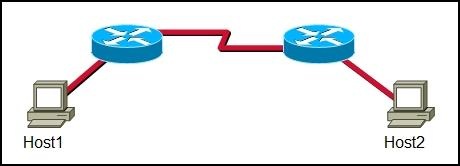
4. Refer to the exhibit. Host1 is in the process of setting up a TCP session with Host2. Host1 has sent a SYN message to begin session establishment. What happens next?
• Host1 sends an ACK message to Host2.
• Host1 sends a SYN message to Host2.
• Host1 sends a SYN-ACK message to Host2.
• Host2 sends an ACK message to Host1.
• Host2 sends a SYN message to Host1.
• Host2 sends a SYN-ACK message to Host1.
5. What are three characteristics of network reliability? (Choose three.)
• Redundant hardware provides enhanced reliability.
• Reliability is measured as a percent.
• Reliability is the responsibility of the ISP customers.
• Fault tolerance is a measure of reliability.
• The longer the MTBF, the greater the reliability.
6. Which two statements describe the FTP protocol? (Choose two.)
• It uses well-known port 23.
• The protocol interpreter is responsible for the data transfer function.
• In passive data connections, the FTP client initiates the transfer of data.
• It requires two connections between client and server.
• FTP servers open a well-known port on the client machine.
7. What is the function of the TCP three-way handshake?
• It enables the synchronization of port numbers between source and destination hosts.
• It immediately triggers the retransmission of lost data.
• It synchronizes both ends of a connection by allowing both sides to agree upon initial sequence numbers.
• It identifies the destination application on the receiving host.
8. What are three characteristics of HTTPS? (Choose three.)
• It uses a different client request-server response process than HTTP uses.
• It specifies additional rules for passing data between the application and data link layers.
• It supports authentication.
• It allows more simultaneous connections than HTTP allows.
• It encrypts packets with SSL.
• It requires additional server processing time.
9. Which DNS zone resolves an IP address to a qualified domain name?
• dynamic lookup
• forward lookup
• resolution lookup
• reverse lookup
10.
What type of update allows client computers to register and update their resource records with a DNS server whenever changes occur?
• dynamic
• zone transfer
• local recursive query
• root domain query
• top-level domain query
11. Refer to the exhibit. Which two statements are true about this file? (Choose two.)
• If the gateway address changes, the file will be updated dynamically.
• The command ping fileserv will use IP address 172.16.5.10.
• If the ping www.cisco.com command is issued, the file will be checked for the Cisco web server IP address before DNS is queried.
• The file must be created by the user if it is to be used by a workstation.
• Name to IP address mappings are added to the file after they are received from DNS.
12. Which two tasks are the responsibility of the local DNS server? (Choose two.)
• maintaining a large number of cached DNS entries
• maintaining the ISP server
• mapping name-to-IP addresses for internal hosts
• forwarding name resolution requests to a caching-only server
• forwarding all name resolution requests to root servers on the Internet
13. What are three unique characteristics of UDP? (Choose three.)
• connection oriented
• full-duplex operation
• low overhead
• no flow control
• no error-recovery function
• reliable transmission
14. A manufacturing company is looking into subscribing to services from a new ISP. The company requires hosted world wide web, file transfer, and e-mail services. Which three protocols represent the key application services that are required by the company? (Choose three.)
• FTP
• HTTP
• ICMP
• PPP
• Telnet
• SMTP
15. Which two options correctly match protocol and well-known port number? (Choose two.)
• DNS - 25
• FTP - 110
• HTTP - 80
• POP3 - 25
• SMTP - 25
16. Within TCP, what combination makes up a socket pair?
• source port with destination port
• source IP address with destination port
• source IP address and destination IP address
• source IP address and port with a destination IP address and port
17. Which protocol is used to send e-mail, either from a client to a server or from a server to another server?
• SNMP
• FTP
• SMTP
• HTTPS
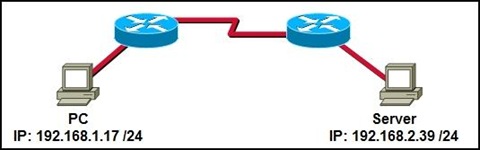
18. Refer to the exhibit. The PC is requesting HTTP data from the server. What is a valid representation of source and destination sockets for this request?
• Source - 192.168.1.17:80 ; Destination - 192.168.2.39:80
• Source - 192.168.1.17:80 ; Destination - 192.168.2.39:1045
• Source - 192.168.1.17:1045 ; Destination - 192.168.2.39:80
• Source - 192.168.1.17:1045 ; Destination - 192.168.2.39:1061
19. What type of DNS server is typically maintained by an ISP?
• caching-only
• root
• second-level
• top-level
20. A client is communicating with a server on a different segment of the network. How does the server determine what service is being requested by the client?
• The server will apply the default service configured in directory services.
• The server will use ARP to discover the appropriate service from the local router.
• The server will send a request to the client asking for the appropriate service.
• The server will determine the appropriate service from the destination port field.
21.
When a host is communicating with multiple applications on the same server at the same time, which of the following will have the same value for each session? (Choose two.)
• IP address
• MAC address
• session number
• sequence number
• The two bottom layers of the TCP/IP model make up the bottom layer of the OSI model.
• The TCP/IP model is a theoretical model and the OSI model is based on actual protocols.
• The OSI network layer is comparable to the Internet layer of the TCP/IP model.
• The TCP/IP model specifies protocols for the physical network interconnection.
• The TCP/IP model is based on four layers and the OSI model is based on seven layers.
2. To meet customer expectations, an ISP must guarantee a level of service that is based on what two factors? (Choose two.)
• accessibility
• adaptability
• availability
• reliability
• scalability
3. User1 is sending an e-mail to User2@cisco.com. What are two characteristics of the process of sending this data? (Choose two.)
• It utilizes TCP port 110.
• A TCP connection is established directly between the User1 and User2 client computers in order to send the e-mail message.
• It utilizes a store and forward process.
• The same application layer protocol is used to send the e-mail and retrieve it from the destination server.
• SMTP is used to send the e-mail message to the mail servers.
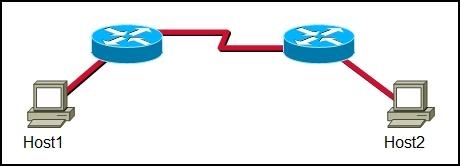
4. Refer to the exhibit. Host1 is in the process of setting up a TCP session with Host2. Host1 has sent a SYN message to begin session establishment. What happens next?
• Host1 sends an ACK message to Host2.
• Host1 sends a SYN message to Host2.
• Host1 sends a SYN-ACK message to Host2.
• Host2 sends an ACK message to Host1.
• Host2 sends a SYN message to Host1.
• Host2 sends a SYN-ACK message to Host1.
5. What are three characteristics of network reliability? (Choose three.)
• Redundant hardware provides enhanced reliability.
• Reliability is measured as a percent.
• Reliability is the responsibility of the ISP customers.
• Fault tolerance is a measure of reliability.
• The longer the MTBF, the greater the reliability.
6. Which two statements describe the FTP protocol? (Choose two.)
• It uses well-known port 23.
• The protocol interpreter is responsible for the data transfer function.
• In passive data connections, the FTP client initiates the transfer of data.
• It requires two connections between client and server.
• FTP servers open a well-known port on the client machine.
7. What is the function of the TCP three-way handshake?
• It enables the synchronization of port numbers between source and destination hosts.
• It immediately triggers the retransmission of lost data.
• It synchronizes both ends of a connection by allowing both sides to agree upon initial sequence numbers.
• It identifies the destination application on the receiving host.
8. What are three characteristics of HTTPS? (Choose three.)
• It uses a different client request-server response process than HTTP uses.
• It specifies additional rules for passing data between the application and data link layers.
• It supports authentication.
• It allows more simultaneous connections than HTTP allows.
• It encrypts packets with SSL.
• It requires additional server processing time.
9. Which DNS zone resolves an IP address to a qualified domain name?
• dynamic lookup
• forward lookup
• resolution lookup
• reverse lookup
10.
What type of update allows client computers to register and update their resource records with a DNS server whenever changes occur?
• dynamic
• zone transfer
• local recursive query
• root domain query
• top-level domain query
11. Refer to the exhibit. Which two statements are true about this file? (Choose two.)
• If the gateway address changes, the file will be updated dynamically.
• The command ping fileserv will use IP address 172.16.5.10.
• If the ping www.cisco.com command is issued, the file will be checked for the Cisco web server IP address before DNS is queried.
• The file must be created by the user if it is to be used by a workstation.
• Name to IP address mappings are added to the file after they are received from DNS.
12. Which two tasks are the responsibility of the local DNS server? (Choose two.)
• maintaining a large number of cached DNS entries
• maintaining the ISP server
• mapping name-to-IP addresses for internal hosts
• forwarding name resolution requests to a caching-only server
• forwarding all name resolution requests to root servers on the Internet
13. What are three unique characteristics of UDP? (Choose three.)
• connection oriented
• full-duplex operation
• low overhead
• no flow control
• no error-recovery function
• reliable transmission
14. A manufacturing company is looking into subscribing to services from a new ISP. The company requires hosted world wide web, file transfer, and e-mail services. Which three protocols represent the key application services that are required by the company? (Choose three.)
• FTP
• HTTP
• ICMP
• PPP
• Telnet
• SMTP
15. Which two options correctly match protocol and well-known port number? (Choose two.)
• DNS - 25
• FTP - 110
• HTTP - 80
• POP3 - 25
• SMTP - 25
16. Within TCP, what combination makes up a socket pair?
• source port with destination port
• source IP address with destination port
• source IP address and destination IP address
• source IP address and port with a destination IP address and port
17. Which protocol is used to send e-mail, either from a client to a server or from a server to another server?
• SNMP
• FTP
• SMTP
• HTTPS
18. Refer to the exhibit. The PC is requesting HTTP data from the server. What is a valid representation of source and destination sockets for this request?
• Source - 192.168.1.17:80 ; Destination - 192.168.2.39:80
• Source - 192.168.1.17:80 ; Destination - 192.168.2.39:1045
• Source - 192.168.1.17:1045 ; Destination - 192.168.2.39:80
• Source - 192.168.1.17:1045 ; Destination - 192.168.2.39:1061
19. What type of DNS server is typically maintained by an ISP?
• caching-only
• root
• second-level
• top-level
20. A client is communicating with a server on a different segment of the network. How does the server determine what service is being requested by the client?
• The server will apply the default service configured in directory services.
• The server will use ARP to discover the appropriate service from the local router.
• The server will send a request to the client asking for the appropriate service.
• The server will determine the appropriate service from the destination port field.
21.

When a host is communicating with multiple applications on the same server at the same time, which of the following will have the same value for each session? (Choose two.)
• IP address
• MAC address
• session number
• sequence number
Langganan:
Postingan (Atom)